
The idea
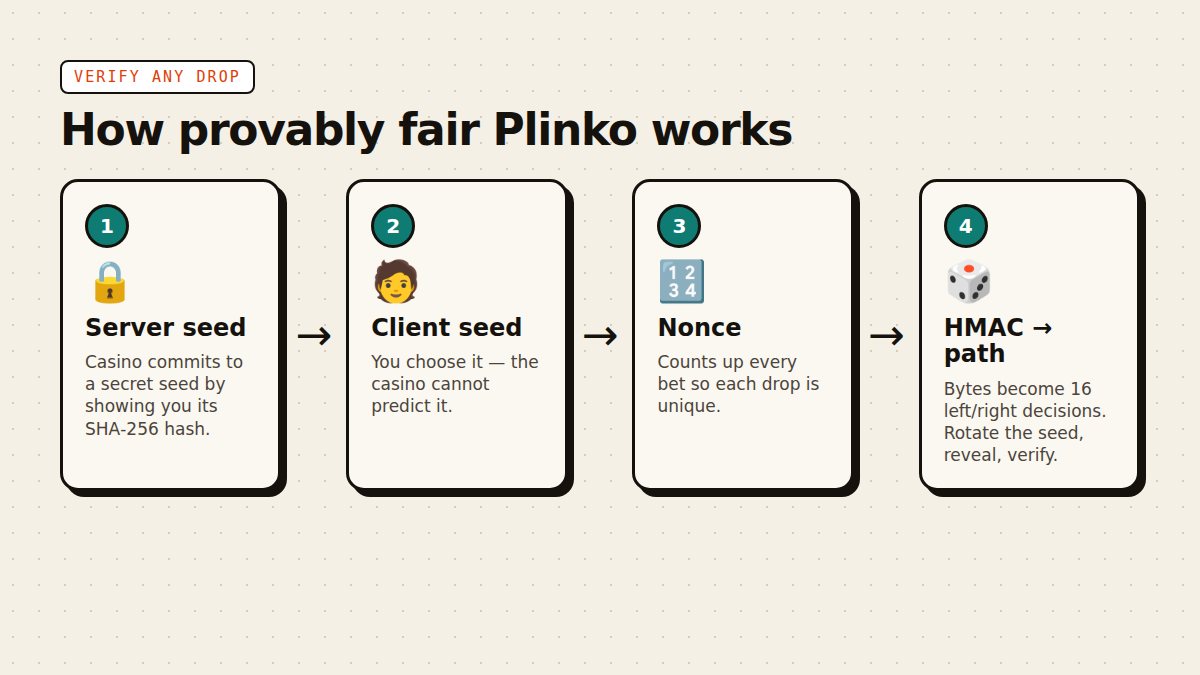
A provably fair game lets you verify, after the fact, that each result was determined by numbers fixed before you bet — so the operator could not have changed the outcome once it saw your stake. Every casino in our ranking implements it on Plinko the same way.
The three inputs
- Server seed — a secret random string generated by the casino. Its SHA-256 hash is shown to you before you play, committing the casino to it.
- Client seed — a string you can set yourself. Change it to anything; the casino cannot predict it.
- Nonce — a counter that increases by one with every bet, so each drop uses a fresh combination.
How a drop is generated
The three inputs are combined with HMAC-SHA256 to produce a stream of bytes. For Plinko, each row's left/right decision is derived from a chunk of that stream (typically four bytes → a number in [0,1); below 0.5 is left). Sixteen rows, sixteen decisions, one bucket. The animation is drawn afterwards to match.
Verifying
- Before playing, note the server seed hash shown in the fairness panel.
- Play a session.
- Rotate the seed. The casino reveals the old server seed in plain text.
- Check that SHA-256 of the revealed seed equals the hash you noted.
- Paste server seed, client seed and any nonce into the site's verifier (or an open-source one) and confirm it reproduces the bucket you were paid for.
What it does and does not prove
It proves each individual result was not altered after you bet. It does not prove the paytable is fair — that is a separate check, and it is why we publish the multiplier tables with computed RTP. It also does not protect you from the operator refusing a withdrawal; for that, track record and licensing matter, which is where our review scores come in.
FAQ
Can a provably fair Plinko be rigged?
Not on a per-bet basis if you verify the seeds. The paytable's fairness is a separate question — compare it against published tables.
Do I have to verify every drop?
No. Verifying a handful after a seed rotation is enough to confirm the system works as claimed.