
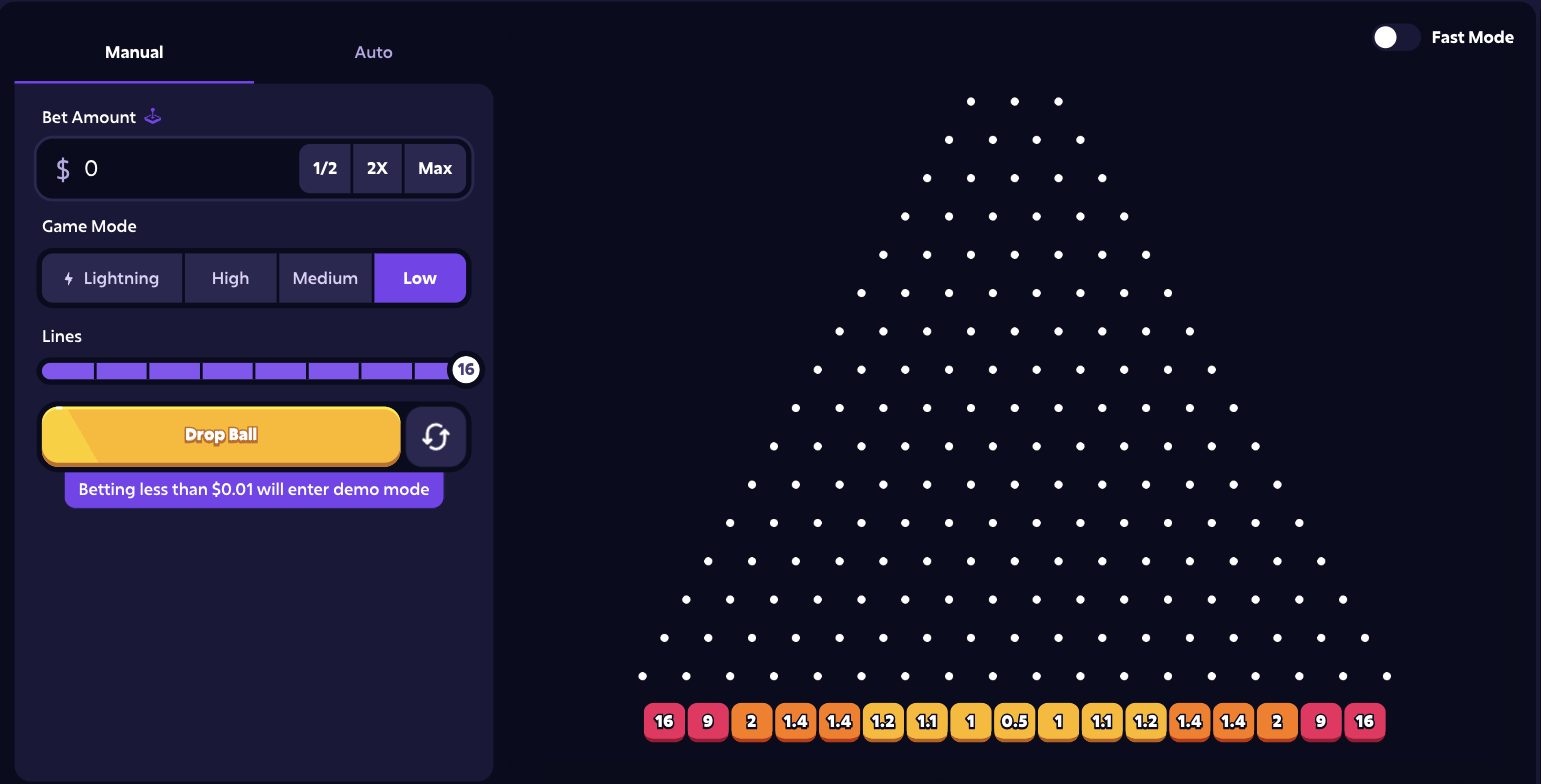
The board
Plinko is a triangular pegboard. A ball is released at the top centre and falls through rows of pegs; at each peg it goes left or right with equal probability. At the bottom is a row of buckets, one more than the number of rows, each with a multiplier. Your payout is the stake times the multiplier of the bucket the ball lands in. That is the entire rulebook.
The three settings
- Rows (8 to 16) — more rows means more buckets, a thinner centre and larger corner multipliers.
- Risk (low, medium, high) — changes the paytable shape, not the house edge. Low pays close to 1× almost everywhere; high pays 0.2× across the middle and hundreds to 1,000× at the edges.
- Bet — any amount from the site's minimum (a cent or so in crypto) to its maximum.
A drop, step by step
- Choose rows, risk and bet.
- Press Bet (or configure auto-bet).
- The site generates the result from a hashed server seed, your client seed and a nonce — the animation you watch is a picture of a result already decided. See provably fair Plinko.
- The ball lands; the bucket multiplier is applied to your stake and credited instantly.
Multipliers below 1×
The centre buckets pay less than your stake — 0.5× on low, 0.3× on medium, 0.2× on high (16 rows). These are the "losing" outcomes, but note you get part of the stake back, which is why Plinko sessions on low risk drift rather than crash.
What the rules do not include
There is no skill element. You cannot aim the ball, time the drop or influence the path. Some sites let you drop several balls at once or choose a colour; these are cosmetic. The only decisions with consequences are the three settings and when you stop — covered in our strategy guide.
Practise on the free simulator, which follows these rules exactly with virtual credits.
FAQ
How many buckets does Plinko have?
One more than the number of rows: 9 on an 8-row board, 17 on a 16-row board.
Can you aim the ball in Plinko?
No. Each peg is a fair 50/50 and the result is generated before the animation plays.